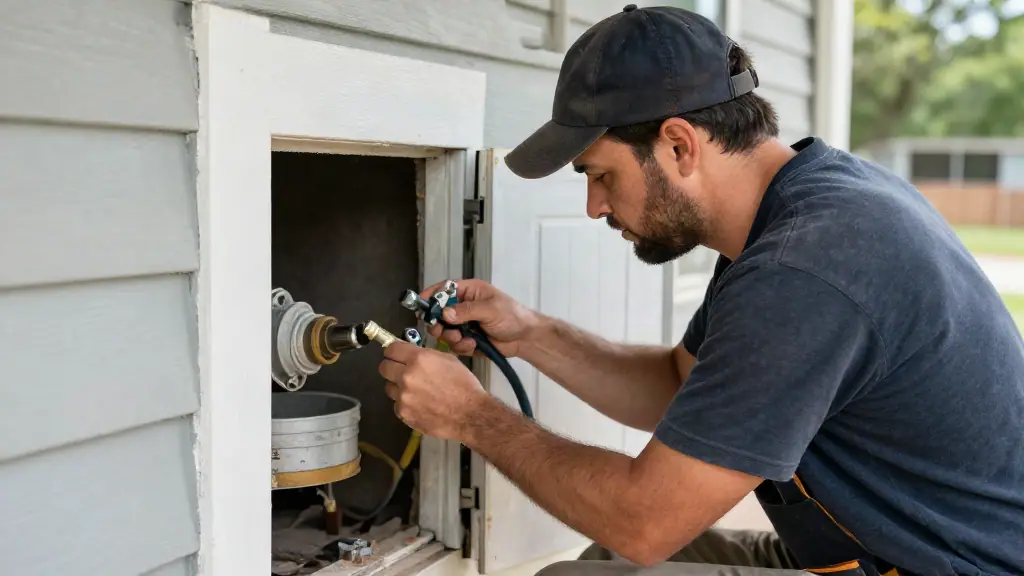
We assess and repair residential gas piping in Austin, Texas.
Gas Line Repair Austin: Find the Fault, Plan the Fix
For gas line repair Austin homeowners need a clear answer about what failed, what we need to reach, and what has to happen before the gas comes back on. We start with the affected line and explain the next step without assuming the whole system needs replacement. If you smell gas or hear hissing, leave immediately, avoid operating switches, and call 911 and your gas utility from a safe location.
What Gas Line Repair Austin Homes May Need
We first ask what prompted the repair: a utility notice, damage found during remodeling, corrosion on an exposed pipe, or an appliance technician’s report. Those details help us distinguish a suspected problem from a confirmed defect. We identify the appliances served by the line, look at the piping we can safely access, and establish where customer-owned piping ends and utility equipment begins. A meter location can help orient us, but it does not tell us where every branch runs. We use observations at the property and any available records to establish which part of the system actually needs attention.
Once we have enough information, we explain what the repair would cover and where we need access. A problem at an exposed fitting might not require opening a wall. A damaged section that runs into a finished ceiling is a different job, especially if we cannot see where the next sound connection is. We consider the condition of the surrounding piping before recommending a repair boundary. We also look at how the work affects other appliances, because the line we need to take out of service may feed more than the range or water heater that first brought the problem to light.
Before work begins, we make clear which parts of the system need to remain out of service. We do not treat a utility shutoff, lock, or tag as permission to restore gas. Depending on the scope and the property, we may need to account for permits, an inspection, or a separate visit from the utility. We explain those dependencies before you plan around a return to service. In a shared building, we also need to know who can authorize access and whether the piping serves more than one unit. That changes whom we coordinate with and which occupants need to know about the work.
After the physical repair, we verify the affected piping under the requirements that apply to the job. That verification determines whether the work is ready for the next step, which could be an inspection or utility clearance rather than immediate gas service. We explain what was repaired, what was checked, and whether any area was outside the scope of the work. If a wall or cabinet opening still needs attention, we point it out rather than leaving you to discover it later. We make the distinction between a completed pipe repair and a system that has been cleared to return to use.
Why Homeowners Choose Us for Gas Line Work
The useful answer is not just that a pipe needs work. We explain where the problem is, what the evidence shows, and what each repair option means for your home and the appliances you rely on.
We explain what the evidence supports
A gas odor report, a utility tag, and a visible defect tell us different things. We read the notice if you have one and compare it with what we can confirm at the property. If the source remains uncertain, we say so and explain what further assessment would establish. That distinction keeps us from blaming a nearby appliance just because it sits closest to the reported problem, or recommending pipe replacement based on appearance alone.
We consider the pipe around the fault
A single damaged fitting can call for a focused repair. Several deteriorated sections on the same run raise a different question about where sound piping begins. We explain how the surrounding condition affects our recommendation, including what we can see and what remains concealed. If a larger section makes sense, we explain why in terms of the pipe, its connections, the access required, and the likelihood of leaving another visibly deteriorated connection on the same run.
We discuss access before opening a surface
A pipe behind a range or in a garage may be straightforward to reach, while the same kind of fault behind tile or built-in cabinets may involve more disruption. We explain the access we expect to need and separate the gas piping scope from finish work. If a route through an accessible space is a practical alternative, we discuss it alongside the original route so you understand the tradeoffs before choosing how to proceed.
We make the next step clear after a shutoff
When the utility has shut off service, it matters who has authority to remove a lock or tag and what has to happen first. We explain which work falls on the customer side and flag any inspection or utility step we know will remain. We do not present a completed pipe repair as permission to turn the gas back on. We also tell you which appliances or areas may still be affected while those steps are pending.
Our Gas Line Repair Austin Process
We separate the assessment, repair, and return-to-service steps so you know what is complete and what still needs clearance. This process starts once any immediate hazard has been addressed by emergency responders or the utility.
1. Review the report
We ask which building, room, or appliance the report concerns and whether the utility has left written instructions. We also ask which equipment is currently out of service and whether anyone recently worked near the line. A remodel date, appliance change, or exterior impact can help us focus the assessment. For a condo or rental, we establish who can provide access and authorize work on the affected piping.
2. Establish the affected section
We look at accessible routing, connections, and shutoffs to determine which part of the piping serves the area in question. We compare any known defect with the condition of the nearby line and note where the route disappears from view. If the route is unclear, we explain what we can establish without opening a surface and what additional access would let us confirm before deciding how much pipe is involved.
3. Explain the repair scope
We describe whether the issue calls for attention at one connection, replacement of a section, or a different route around a damaged or inaccessible area. We tell you where the work would take place and which appliances may be affected. We also identify foreseeable permit, inspection, or utility requirements. If findings could change once the pipe is exposed, we explain that uncertainty as part of the proposed scope.
4. Complete the piping work
We carry out the agreed repair using components suited to the existing gas piping system and its location. If access reveals damage beyond what we expected, we explain what changed and how it affects the repair boundary. We keep the affected line out of service while work and required checks are underway. We also keep track of any adjacent equipment or opening that needs attention before the area can be put back in use.
5. Verify the work and review service status
We complete the applicable checks and explain the result in terms of the section repaired. We distinguish any required inspection from the check we perform on the piping itself. Before we finish, we tell you what is ready, what must remain off, and who handles any remaining clearance or restoration. If the utility controls the shutoff, only the utility can remove its lock or tag and authorize the relevant next step.
How Austin Homes Shape the Repair
In East Austin, older houses and newer infill can sit on the same block, but their gas piping may take very different routes. A bungalow on piers can have a branch running through a low crawl space, while a newer house nearby may conceal much of the route behind finished walls. In the older house, additions or a kitchen remodel may have changed the route from what the original layout suggests. We use visible piping and reliable property records where available rather than treating the age of the home as a map. The useful distinction is which connections we can reach and which ones require further access.
Around South Congress, a remodeled bungalow may still have an older section of piping feeding a newer range. In North Austin, slab-on-grade houses often leave fewer underfloor access options, but an exposed garage wall or utility area may give us a useful view of the route. Exterior piping near a side yard or driveway brings a different set of concerns, including impact from yard work and corrosion where exposed metal stays damp. We also ask about recent fencing, landscaping, or an addition when a buried customer-owned line is in question. We do not assume the closest visible pipe is the one affected.
Downtown Austin condos near Lady Bird Lake and apartment buildings in West Campus can add an access issue that a detached house does not have. A shutoff, mechanical room, or section of shared piping may be outside the unit, and a resident may not be able to authorize work there. We identify which part of the system the report concerns before assuming a single-unit repair is possible. When management controls access or the line serves other units, those details affect how much of the piping can be assessed and when it can be taken out of service. We separate those building decisions from the repair itself.
How We Keep the Work Scope Clear
We explain what we know while the piping is still accessible and identify any decisions that belong to the property owner, building management, an inspector, or the utility.
We separate findings from assumptions
A pipe that disappears behind a cabinet is a route we have not fully confirmed, not a reason to describe the entire cabinet wall as damaged. We tell you what is visible, what we learned from the assessment, and what remains unknown. That keeps a preliminary finding from turning into an unnecessary opening. It also helps you understand why we may need to see another part of the line before recommending a permanent repair.
We account for the rest of the gas system
Repairing a branch can affect a range, furnace, or water heater even when only one appliance was mentioned in the original report. We identify the equipment on the affected section as far as the routing allows and explain what the interruption means. If the practical scope changes because a valve controls more than expected or access is shared, we point that out before treating the work as a simple one-appliance repair.
We distinguish cleanup from finish restoration
We keep the immediate work area organized and remove debris from the piping work. A cabinet panel, drywall opening, or other finish disturbed for access is a separate matter from the pipe repair. We identify those surfaces and distinguish basic cleanup from work such as patching, painting, or resetting a built-in panel. We also note any opening that needs to stay accessible until an inspection or another required check is complete.
We explain what the final check covers
The scope of the check matters as much as the result. We tell you whether it covered a single branch, a replaced section, or a broader part of the system. We do not extend that result to concealed sections or appliances that were outside the assessment. If there is a remaining question about an appliance or a separate branch, we identify it rather than implying the piping repair resolved every issue in the building.
What a Typical Repair Includes
The exact scope depends on where we find the problem and which piping we can access. We outline the applicable items before work so a repair to one section is not mistaken for an assessment of every gas connection on the property.
- Review of the reported problem, any utility notice, and relevant plumbing or remodeling work.
- Assessment of accessible customer-owned gas piping, including the connections and supports near the affected section.
- Identification of appliances served by the affected branch where routing and available records allow.
- Explanation of repair limits, access needs, and sections that cannot be assessed without additional openings.
- Work on the confirmed connection or section using components appropriate for the gas piping system.
- Applicable checks on the repaired piping, with an explanation of what those checks cover.
- Removal of piping debris from the immediate work area and identification of any remaining openings.
- Review of gas service status and any outstanding inspection, access, or utility restoration requirements.
Problems We Address With Gas Pipe Repairs
We repair defects in customer-owned fuel gas piping. An appliance fault, a problem on utility-owned equipment, or an unexplained performance change can look like a piping issue at first, so we establish the source before assigning it to the line.
A confirmed leak at a pipe connection
A leak may be reported at a fitting near a range, a water heater, or an accessible branch. Once the immediate hazard has been addressed, we determine whether the connection itself or the adjoining pipe needs attention. We also look at nearby support and condition so the scope reflects what we actually find, not just the spot named in the initial report.
Corrosion on exposed metal piping
Discoloration on a pipe is not enough to decide how far a repair should go. We assess the visible condition, including whether corrosion appears concentrated near a support, an exterior penetration, or a damp area. If deterioration extends along a run, we explain where it is visible and which parts would need more access before we can determine a sensible boundary.
Physical damage after renovation or yard work
Cabinet changes, demolition, and exterior work can expose a line to impacts or leave it inadequately supported. We assess the affected section and nearby connections rather than judging the pipe only by how it looks from across the room. If there is suspected contact with a buried line, the utility or emergency responders must address the immediate hazard before a customer-side piping assessment proceeds.
An appliance branch that no longer fits the layout
Moving a range or changing a utility room can leave the existing branch in a location that no longer works for the equipment or the room. We assess the pipe route, the location of the shutoff, and the appliance requirements before describing what needs to change. We distinguish fixed building piping from the appliance connector so the repair addresses the correct part.
An old branch that is no longer in use
A former appliance location can leave a gas branch behind a cabinet or along a wall. We determine whether it is still connected to the active system and whether it serves anything else before recommending how to deal with it. The fact that a branch is no longer used does not tell us whether it has been properly taken out of service.
A customer-side issue documented by the utility
A utility notice can identify a condition to investigate without specifying every part of the repair. We use the notice to guide the assessment and explain how our findings relate to the area named. If the issue turns out to fall outside customer-owned piping, we distinguish that from work we can address and leave the utility’s equipment and controls to the utility.
When to Call About a Gas Line
If you smell gas, hear hissing near a gas line, or suspect an active leak, leave immediately. Do not operate lights, appliances, or phones inside. From a safe location, call 911 and your gas utility. Do not reenter until responders say it is safe. The signs below are reasons to arrange a piping assessment once any immediate hazard has been addressed.
- The gas utility left a notice identifying a defect on the customer side of the system.
- You can see corrosion where an exterior gas pipe enters the house or passes through a support.
- A contractor working on a remodel reports damage to a gas line or its mounting.
- An appliance installer identifies a problem with the fixed gas piping during an equipment replacement.
- An exposed gas branch appears bent, poorly supported, or out of position after nearby work.
- A renovation uncovers an old gas branch and you cannot confirm whether it is active.
- Several gas appliances behave differently after a piping change, and no immediate hazard has been identified.
Tools and Materials We Use to Assess the Line
We choose tools and components for fuel gas piping, not by resemblance to water plumbing parts. We check the system type, the installation location, and the requirements that apply before specifying a fitting or deciding how to verify the completed work.
Pressure gauges for verification
We use a pressure gauge suited to the applicable test to check the piping within the defined scope. The test is not the same as checking whether an appliance lights, and a reading on one section does not tell us about piping outside that section. We explain the test boundary and whether a separate inspection or utility review remains before service can be restored.
Gas detection tools for accessible areas
A combustible gas detector can help us evaluate accessible areas as part of a professional assessment. We consider its indications alongside the utility report, visible pipe condition, and the route of nearby branches. A reading in one area does not necessarily identify the exact connection at fault. We do not treat a detector reading as a substitute for the required verification of repaired piping.
Pipe wrenches and system-specific tools
We use a pipe wrench where the existing threaded assembly calls for it and select other tools to suit the actual piping system. When a press connection is appropriate, the press tool and fitting must be compatible with each other and approved for that fuel gas application. A tool used for water lines is not automatically suitable for the gas piping beside them.
Fittings and sealants selected for fuel gas
We check that replacement pipe, valves, and fittings are approved for the intended fuel gas service and match the system being repaired. A brass fitting that looks like the original may have been designed for another use. The same distinction applies to pipe joint compound, sometimes called pipe dope, and thread seal tape. We do not assume a water plumbing product is suitable for gas.
Route assessment before choosing access
We start with the visible pipe, accessible chases, and any reliable plans or recent work records. For a concealed section, we compare what is known at each accessible point and explain where the route is still uncertain. That helps us choose where more access would provide useful information. We do not treat a pipe inspection camera used for drains as a way to verify gas line integrity.
Gas Line Repair Austin: Permits, Property Access, and Utility Service
When you search for “gas line repair Austin,” the first local detail we need is the service address. An Austin mailing address does not always tell us which jurisdiction handles permits or who provides gas service. Within the city, Austin Development Services is the place to confirm permit and inspection requirements for the proposed work. The gas utility has a separate role, particularly if it has shut off service or the concern involves its equipment. We keep those responsibilities separate when discussing the job so you know which decisions depend on the city, the utility, or the property owner.
In East Austin, an older bungalow with a crawl space may sit next to a newer home on a slab. Around South Congress and Travis Heights, a rear addition or a converted garage can put a gas appliance farther from the original part of the house. We don't assume that two homes of the same age have the same pipe layout. If you know when the kitchen, laundry room, or water heater was moved, tell us when you call. That history can help explain why an apparently short distance on a floor plan doesn't always mean straightforward access.
In Downtown Austin and West Campus, access can matter as much as the address. A resident may be able to open a unit but not the locked room containing building equipment, and a repair affecting a shared line may need approval from someone who isn't on site. We ask who can authorize the work and who can provide access to the relevant areas. If you manage a building, it helps to say whether tenants share any gas equipment and whether other units have already been notified of an outage. That gives us a clearer picture without asking residents to investigate.
In North Austin, gas piping may serve an outdoor grill or patio appliance as well as equipment indoors. A route beneath finished landscaping can change what is practical to repair and what will need to be put back afterward. Seasonal conditions affect planning, too: after heavy rain, a side yard can be difficult to reach, while a winter cold snap makes a furnace outage more disruptive for the household. We ask what equipment is out of service and which parts of the property are accessible. Weather and inconvenience matter for planning, but neither tells us where a gas problem started.
A Typical Gas Line Repair Example in South Congress
A shutoff that affects the kitchen range and water heater
The situation
This is an illustrative example, not a specific customer job. In an older house near South Congress and Oltorf Street, the gas utility has shut off service after a reported odor. The occupants are safe, but the house has no hot water and the kitchen range is out of service. The owner knows the kitchen was remodeled but doesn't have a record of whether the gas piping was rerouted. A short section is visible in a utility closet; the rest of the route is unclear. The owner wants to know whether that visible section can be repaired or whether the finished kitchen wall will also have to be opened.
What we did
In this example, we would ask for the utility's shutoff paperwork, if available, and distinguish what it says from what the owner remembers about the remodel. We'd identify which equipment is affected, confirm who can approve access, and explain what we can evaluate without opening a finished surface. A narrow repair makes sense to discuss if the problem is confined to one accessible section and the remaining piping can stay in service. If the condition or routing points to broader work, we'd explain why and identify the additional area involved. Before the owner decides, we'd separate the piping work from any wall restoration and explain the permit, inspection, or utility steps that apply.
The result
In one plausible outcome, the issue is confined to a short branch accessible from the utility closet, so the kitchen wall stays intact. The owner knows which section the proposed repair covers, which piping is outside that scope, and whether any access work is expected. The repaired piping must meet applicable testing and inspection requirements before the relevant party authorizes restoration. If the utility must return, we explain that a finished repair does not mean the range and water heater can be used that evening. The useful takeaway is not that repairs in older South Congress homes stay small. It's that the owner can plan around a defined scope and knows who controls the remaining steps.
Gas Line Repair Austin: Typical 2026 Cost Ranges
We use these estimated 2026 Austin-area market ranges for orientation only. They are not quotes or our published fees. The rows describe different job scenarios, so don't add them together. A property-specific price depends on the affected piping, access, and which testing, inspection, or restoration items the proposed scope includes.
| Job | Typical range | Notes |
|---|---|---|
| Assessment of an accessible gas piping concern | $150–$350 estimated | This range is for evaluation rather than repair. Confirm whether formal testing is included in the proposed assessment, particularly if the affected piping serves more than one appliance. |
| Repair at one accessible connection | $250–$650 estimated | This assumes the problem is limited to a connection on customer-side piping with clear access. A problem inside the appliance itself calls for a separate scope. |
| Replacement of a short exposed pipe section | $450–$1,200 estimated | This assumes there is room to work without opening walls or excavating, and that the piping beyond the affected section does not need replacement. |
| Repair involving a concealed branch | $800–$2,500 estimated | The route and the opening needed to reach it drive this range. Don't assume drywall, tile, cabinet, or paint restoration is included in the plumbing scope. |
| Repair of a buried customer-side section | $1,200–$4,000 estimated | This range assumes limited excavation. Rock, nearby utilities, or a route beneath paving can change the scope substantially, as can landscape or hardscape restoration. |
| Replacement of a longer damaged run | $2,500–$7,500 or more estimated | A longer run or multiple appliance branches may call for a broader design and inspection scope. Compare what each proposal covers rather than judging by the dollar figure alone. |
What affects the price
- We distinguish a localized defect from damage that extends into adjoining pipe because the condition of that pipe affects whether a small repair is a practical option.
- A clear route through a utility room costs less to access than piping behind built-in cabinetry, above a shared ceiling, or below a finished patio.
- The number of appliances on the affected section can influence the scope, particularly when several branches must be evaluated rather than one short connection.
- Permit and inspection requirements depend on the address and work, so we discuss which items belong in the proposed plumbing scope and which are separate.
- For buried piping, shallow limestone, tree roots, limited equipment access, and nearby utilities can all make two runs of the same length different jobs.
- Putting back drywall, tile, planting beds, or paving can change the total project budget, so we separate those costs from the piping work when comparing options.
Typical market ranges for guidance only, not a quote. Call for a price for your job.
Austin Gas Line Repair FAQs
What should I do if I smell gas in my Austin home?
Leave the building immediately and get everyone out. Don't use a phone inside, operate lights or switches, light a flame, or stay to look for the source. Once you're outside and a safe distance away, call 911 or the gas utility's emergency line. Don't reenter until emergency responders or the utility say it's safe. A suspected leak is not a routine plumbing appointment, so don't wait for a return call from us before leaving or reporting it. Once the immediate danger has been addressed and it's safe to discuss repairs, tell us whether the utility shut off service or left written instructions.
Do I need a permit to repair a gas line in Austin?
That depends on the property address and the work proposed. For a property inside Austin's city limits, Austin Development Services can clarify the applicable permit and inspection requirements. Nearby properties with Austin mailing addresses may be in another jurisdiction. We don't assume that a repair is exempt just because it's short or because the pipe is already there. Before work is authorized, ask who will handle any required permit and inspection and how those items appear in the scope. Also ask what the utility needs if service has been shut off. City inspection and utility restoration are separate responsibilities.
Who repairs a gas line near the meter or outside my home?
The gas utility generally handles its meter and supply equipment, while the property owner is generally responsible for piping on the customer side. The utility can confirm the exact point where responsibility changes at your address. A pipe being outside, near the meter, or buried across the yard doesn't settle that question by itself. For a non-emergency call, we can use any utility notes you've received to put the request in context. If you smell gas or hear unexplained hissing near the equipment, move away and report it from a safe location rather than trying to identify the owner yourself.
Can one section be repaired, or do I need a new gas line?
One accessible section can sometimes be repaired or replaced while the rest stays in service. The key question is whether the problem ends there and whether the adjoining pipe is in suitable condition. Replacing a longer run may make more sense when deterioration extends beyond one spot, when a concealed route is especially difficult to reach, or when an earlier remodel left an unclear layout. We explain what supports the narrower or broader recommendation, including which surfaces each option would affect. A bigger repair should address an identifiable problem, not simply be a reaction to the age of the house.
How long will the gas be off during a line repair?
We separate time spent on the piping from time without gas service. An accessible repair can involve less on-site work than a buried or concealed line, but that doesn't establish when service can resume. Required testing, inspection availability, and utility authorization can affect the schedule. If an outage affects several appliances, tell us which ones your household is relying on, especially heat in cold weather or hot water in a shared building. We can explain which parts of the timeline are known and which depend on another party. Don't attempt to restore service yourself after a utility shutoff.
Can a landlord or condo association arrange gas line repair?
Yes. For a rental or condo, we ask who can approve the work, who can provide access, and who will communicate with occupants. Piping that serves only one unit and piping shared by several units may fall under different responsibilities. The lease, association documents, or property manager may clarify who can act for the affected area. A resident should never wait for that approval to report a suspected leak from a safe location. Once the emergency has been addressed, having one contact for access and one for approvals can help avoid delays, especially where common rooms or occupied units are involved.
What should I check before hiring someone for gas line repair in Texas?
We suggest checking the relevant plumbing credentials through the Texas State Board of Plumbing Examiners and asking who is responsible for the proposed gas piping work. Ask for a scope that identifies the affected line, what is included, and what may cost extra if access or pipe condition differs from expectations. Find out who will handle any required permit or inspection, and who will coordinate with the utility if it controls restoration. If two estimates differ sharply, compare access, testing, and finish restoration before comparing totals. A lower figure may describe a smaller job rather than a lower price for the same work.
What We Explain Before You Approve the Work
At TEST- Austin Plumbing Co, we separate what we can observe from what we still need to confirm. If a utility notice identifies a concern but doesn't say which branch is affected, we won't treat it as a map of your piping. If a line disappears behind a cabinet or under a slab, we explain what that means for the proposed scope before you decide on access. We want you to be able to tell which section the estimate covers, what conditions could change it, and whether putting the room or yard back together is part of the same job. In a finished kitchen, the difference between pipe work and cabinet repair can matter as much to your decision as the length of pipe involved.
We also explain what a completed repair means for your property. The pipe work may be finished while an inspection or utility visit is still outstanding, and those are different milestones when you're planning around an outage. We describe the work in terms you can relay to a household member, landlord, or building manager: the section involved, which equipment it serves, and any remaining steps before service resumes. If the proposed scope changes, we explain what changed and why rather than asking you to approve a larger job without context. You should be able to compare the recommendation with the original concern and understand why a different route, a longer section, or more access is being discussed. That conversation matters whether the line serves a backyard grill or several units in a building.
Reviews of Our Gas Line Repair Service
As you read our reviews, look for details that matter to your property, such as how we explained access, communicated about an outage, or clarified what remained after the repair.

“A pipe burst under our kitchen sink on a Sunday morning in our 1920s bungalow near the Capitol. We called Austin Plumbing Co and they had someone out within a couple of hours. He shut off the water, replaced the corroded section, and checked the nearby lines. No drama, no upsell, just a solid repair. We have used them twice since for smaller issues.”
“Our shower and bathroom sink were draining slowly for weeks. The plumber from Austin Plumbing Co snaked the line and found a hair clog plus some soap scum buildup. He explained what to use to keep it clear and didn't push any expensive treatments. The drain has been fine since. Scheduling was easy and the price matched the estimate.”
“We noticed a soggy patch in the front yard and a sewage smell near the cleanout. Austin Plumbing Co came out, ran a camera, and found a cracked clay pipe from the 1950s. They repaired the section without tearing up the whole yard and left the area clean. They also showed us the camera footage and explained the root intrusion issue.”
Talk With Us About Gas Line Repair in Austin
For a non-emergency repair or follow-up after a utility shutoff, call TEST- Austin Plumbing Co at (542) 254-3225 with your service address and any instructions the utility left. If you smell gas now, leave immediately and call 911 or your gas utility's emergency line from a safe location.
Call About Gas Line Repair · (542) 254-3225